7 min read
Opening
The hidden cost: time
In the 8th edition we asked what matters most to reach the Champions League of the sector. The answers have little statistical relevance but — as promised — here is the result: realism won by a wide margin and optimism didn't get a single vote. Curious, to say the least.
In the 9th edition, we shift the focus to a variable that is often neglected — yet decides whether projects are viable: time. Almost everyone optimises price and product; few put the cost of each passing month into the numbers.
In real estate, time is not neutral. It charges interest — on capital, on indecision, on the market window that keeps closing while you decide.
Over the next pages, the team's sentiment.
Last poll's result
And you — what do you think matters most to reach the Champions League of real estate? (8th edition)
- Honesty & Realism: 54.5%
- Delivery & Results: 36.4%
- Courage & Firmness: 9.1%
- Optimism: 0.0%
André Casaca
In our sector, everyone knows how to calculate price. Few know how to calculate time.
And yet it is time that separates a good deal from a bad one — often with the same price, the same product and the same location.
A feasibility study that closes today with a 20% margin can turn negative just by slipping twelve months.
Not because the market fell, but because money has a cost — and that cost runs every day.
We can call it the hidden cost: the interest paid on waiting, on the decision put off, which never appears in any budget.
Many projects fall short of their expected returns not for lack of merit in those managing them, but because time doesn't turn back.
Permits that took twice as long, late decisions, shifts in market dynamics halfway through development.
Time is probably the most underestimated risk in real estate. And perhaps it is underestimated because it is invisible.
It doesn't appear in the project's written or drawn documents. It doesn't appear in the summary tables. It doesn't appear in market data and statistics. It doesn't appear in the tax records or the land registry certificates.
But it always shows up in the final result. Even when nobody wrote it there.
So I've learned to treat time with great respect.
From my own experience: capital is lost, gained and recovered. Time is harder.
Financing can be renegotiated. Margin can be rebuilt. Time can't.
It is the only resource we spend without being able to replace it. Those who respect it protect value. Those who ignore it usually pay the price.
Sentiment: "Capital can be recovered. Time is harder."
Gonçalo Miguel
There is a constant temptation in our work: speeding up to please.
But the time gained by rushing one stage is usually paid back, with interest, in the next.
A badly prepared application at the start doesn't save time — it pushes it forward, almost always multiplied. What isn't done right the first time gets done three times.
Every stage has a minimum time it requires. Trying to compress it below that minimum is the most expensive way of managing it.
Rigour, contrary to appearances, is what saves time — not what spends it.
Today, when a deadline seems too good to be true, I'm suspicious. In real estate, time rarely forgives shortcuts.
And there is a distinction I consider essential: what is in our hands, we deliver. We follow up, we push, we chase and we give it 200%. But some deadlines don't depend on us. That is precisely why we should never assume a deadline will be met simply because it is desirable or because someone set it. We can commit to work and effort.
The final deadline is set by the process itself.
Sentiment: "The time you save by rushing, you pay back double at the end."
Miguel Amaral
There's nothing like two real examples of how investors look at the time factor:
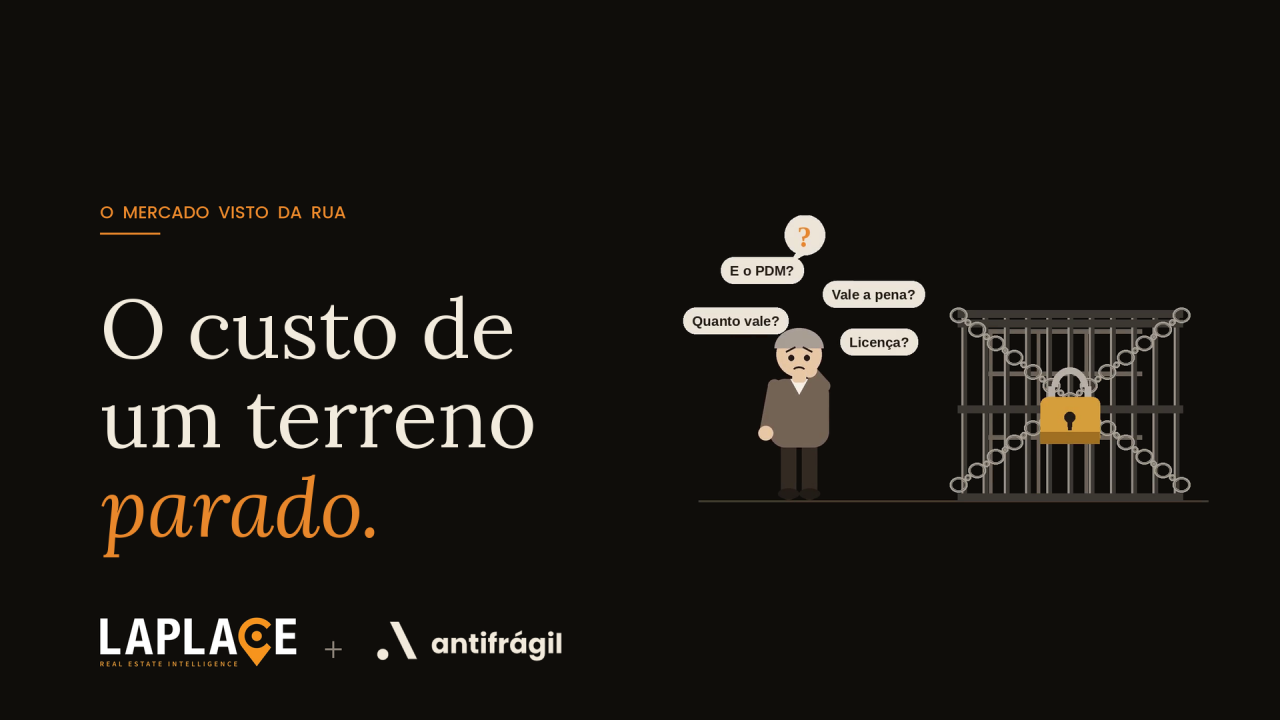
- "To date, although several steps have been taken, we have no binding information from the council, only the PDM parameters. So until there is more concrete information, it looks like a risky asset to me..."
- "We looked at it but it's hard for us to consider something that doesn't have an approved planning instrument."
In sales, time has a very concrete way of charging us: it's called an idle asset.
A property that sits on the market for months isn't just waiting for a buyer — it is losing. It loses in maintenance costs, in tied-up capital and, above all, in perception.
Because the market notices. An asset that lingers starts to look like an asset with a problem, even when it has none. And from then on, time works against the price.
Over the years, I've learned that in sales there are two timing mistakes — and both are expensive:
- Too much time — the asset that drags on the market loses freshness and forces a price cut to make up for the delay. The more time passes, the less negotiating power the seller has.
- Too little time — rushing to market with the asset poorly prepared or badly positioned, and burning the only first impression there is. There are no second premieres.
The right time — neither early nor late — is almost everything. And more than a technique, it is a reading: knowing when the client's silence is doubt and when it is maturing.
On the relationship side, the principle is the same. Trust isn't built in a hurry: a client pushed into a decision rarely comes back; a client given the right time almost always does.
And perhaps that's why, in the 8th edition's poll, readers put Honesty and Realism ahead of everything, with 54.5% of the votes. Handling the other person's time truthfully is worth more than any quick promise.
Sentiment: "In sales, it's not whoever arrives first who wins. It's whoever arrives at the right moment."
Pedro Almeida
There is a cost that is almost never talked about in real estate: the cost of not deciding.
Waiting often seems the safest option. One more study, one more meeting, one more week to think. But every week has a price and, almost always, it is the deal itself that pays it.
Absolute certainty never comes. When you try to eliminate all risk, the opportunity has often already changed price, lost its timing or gone to another buyer.
Deciding with 80% of the information, at the right moment, can be worth more than deciding with 100% when it's too late.
And there is another invisible cost: the opportunities we let pass because we're stuck on one that isn't moving. Idle capital and idle time have a cost too.
This isn't acting in haste. It's knowing the difference between prudence and indecision.
Because in the end, more than losing money, the market often loses time on decisions it never gets round to making.
Sentiment: "The market also loses money when money stands still."
João Franco, the grumpy guest
Time to think
I fear the coming weeks will be the most productive of the year.
More and more I have the feeling I should do half as many projects, not twice as many. It's strange. This isn't about work-life balance or other such mythologies. It's about emptiness. Time to think about things that don't need solving on the spot.
Architects don't design walls. They design the void left in between. In a wall, the most important point is where it stops existing: a door, a window. Perhaps the same is true of the calendar.
The value isn't in the hours filled. It's in the hours left empty to think.
The most productive ideas rarely appear while we're filling in INE's Q3 form. Uninteresting work costs double. It costs the time it consumes and the time it steals from thinking about something better.
I have the feeling we should set aside, every day, one hour in the diary just to think.
Sentiment: "The value isn't in the hours filled. It's in the hours left empty to think."
Poll of the week
Where does time cost most in a real estate process?
- Planning consent
- Investor decision and financing
- Design and designers
- Construction and suppliers
See the results of every poll in the Barómetro do Achismo.
Want the next edition? Subscribe to the Sentimento de Mercado newsletter.
Opinions of the Laplace team on the market. Market information; not investment advice.
Frequently asked questions
Why is time considered a hidden cost in real estate?
Because time charges silent interest on the capital invested, on postponed decisions and on the market window, without ever appearing in budgets, permits or certificates. A feasibility study with a good margin can turn negative simply because the process drags on longer than planned, even with no change in market conditions.
Is it worth rushing a real estate process to save time?
Rarely. Rushing a stage below the minimum time it needs usually costs more, because what isn't done right the first time gets repeated and multiplies the delay in the next stage. What saves time is rigour, not haste.
Does a property lose value by staying on the market too long?
Yes, in two opposite ways. Taking too long reduces negotiating power and forces a price cut; launching the property in a rush, poorly prepared, burns the only first impression there is on the market.
Is it better to wait for more information before deciding on a real estate investment?
Absolute certainty never comes, and waiting for 100% of the information has a cost: the opportunity may change price or go to another buyer. Deciding with about 80% of the information at the right moment is, as a rule, better than deciding late with complete information.
How do investors react to projects without approved planning consent?
With suspicion. Some investors class as risky an asset with no binding information from the council, relying only on PDM parameters, and others won't even look at assets without an approved planning instrument. Uncertainty about time weighs directly on the decision to invest.
Um abraço e até breve
Laplace