5 min read
Gonçalo Carvalho Miguel
This week I'd highlight a few ideas that stood out at a ULI Portugal event.
The public and private sectors operate with very different perceptions of time and exposure to risk. While the private sector is often subject to immediate financial and commercial risks, the public sector tends to be more constrained by legal risk and scrutiny, which naturally shapes decision-making.
In many contexts there is still a "premium on inaction": deciding means taking risks, while not deciding rarely has proportionate consequences. The result is slower processes and lost opportunities.
Adopting a strategic, integrated view of the territory is essential to avoid the effects of fragmented, disjointed decisions. A holistic approach helps speed up processes and minimise problems that end up dragging on over time.
Collaboration and communication between sectors are indispensable for finding more effective solutions. The public sector can't close in on itself or work in isolation from the reality of economic players and civil society. Likewise, the private sector must understand the constraints and responsibilities inherent in public management.
The structural challenges we face demand more dialogue, greater alignment of goals and a culture of cooperation focused on solving problems, rather than simply identifying them.
Sentiment: "We should bring the private and public sectors closer together. It was gratifying to see public and private decision-makers talk openly, without fear and without a script."
André Casaca
After weeks of blocked thinking, with anxiety and uncertainty gaining ground on reason and a constant feeling of "am I doing everything wrong?", I decided to tell a few matters where to go and move on.
Sometimes I forget how good it feels to say: "No. Either I do it properly or I don't do it at all. I'll take the loss, but with a clear conscience."
"Didn't you want to be an entrepreneur, André?" Well, there you go. You just have to learn to carry the pain. (In Portuguese, the pun is that empreendedor — entrepreneur — contains the word dor, pain.)
Changing the subject — this week I won't risk a single reading of the market. The data point to a resilient, dynamic market. On the street, people talk of a change in pace. In the news, of rising interest rates. In the cafés, that "nobody can afford a home". In fact, a lot gets said and little gets done to "make it happen".
Sentiment: "My achismo is that the best entrepreneurs aren't the ones who run into fewer problems. They're the ones who develop an almost irrational ability to keep solving them, one after another, without losing their minds along the way.
Being an entrepreneur isn't learning to make money. It's learning to carry the pain without giving up."
Miguel Amaral, AssocRICS
Some vines are still all leaves and no grapes, but I'd say something positive is about to happen, and I'm not basing that on faith!
About a meeting this week at a council in Greater Lisbon, where the officers, management included, were very friendly and willing to collaborate on the process, now and in future, I came away with the impression that:
- There isn't currently a housing problem being constantly mentioned, debated and identified.
- There won't be European incentives available for it.
- There won't be a cut in construction VAT (with benefits still to be confirmed).
- There are no supposedly simplifying measures for red tape (their usefulness also still to be confirmed).
- There isn't, at bottom, even with debatable measures, any great concern about the issue.
I admit my expectations for the meeting weren't exactly high, and the truth is that this plot's problems are only about 40 years old, so… it'll almost certainly be sorted any minute now!
Sometimes the work done is bad and deserves criticism; sometimes the work is good and gets no recognition from the other side. What to do? In the first case, learn; in the second, nothing — move on. Time is a good friend (to everyone)!
Sentiment: "Bring them on!!"
Pedro Almeida
This week I kept thinking about something simple: sometimes the problem isn't a lack of supply, it's a lack of real estate product matched to demand.
We keep seeing the market, interest and capital. But in several conversations there's a feeling that what is being developed isn't always what people are really looking for. And perhaps that's why so much time is spent arguing about price.
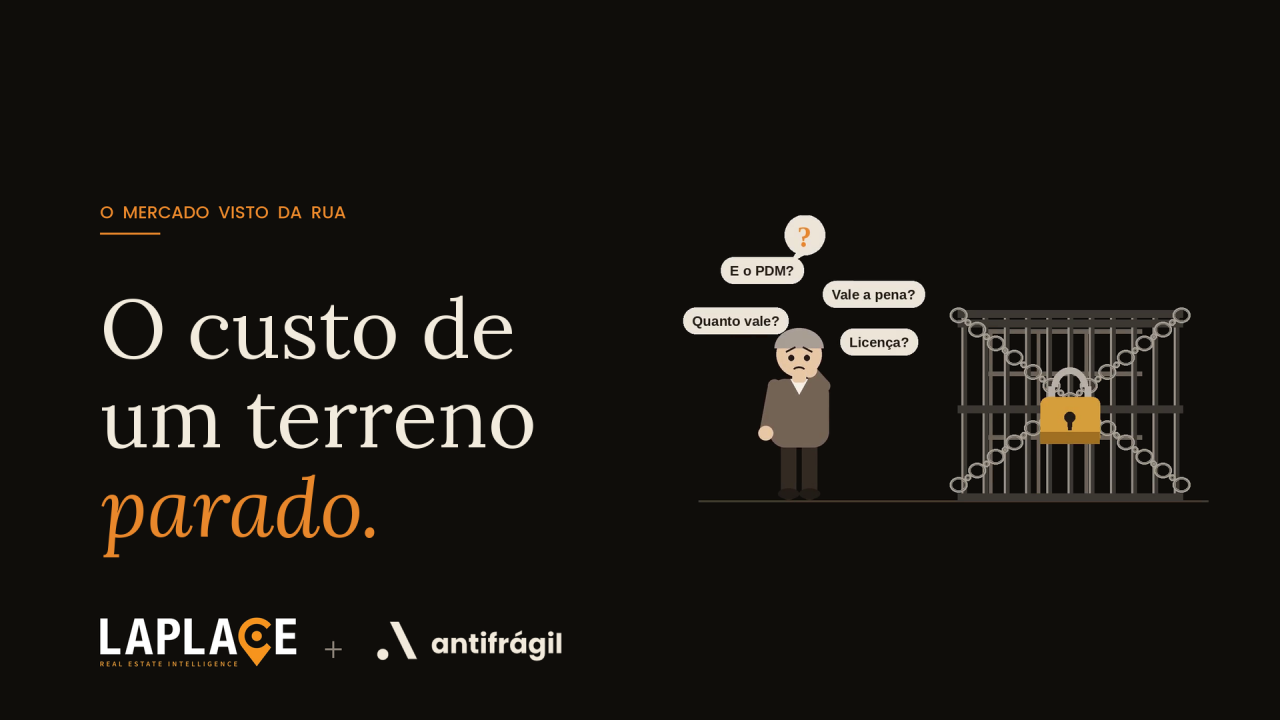
When, before that, the question should be another: does this product really make sense here? Complying with the PDM, the subdivision permit or the regulations is essential, but it isn't enough. Sometimes things get built because they can be built, not because they truly meet demand. When the product meets the market's need, the market tends to value it. When it doesn't fit, the market marks it down.
Sentiment: "While everything is cheap, everything sells. But when sale prices become significant relative to people's average income, whatever doesn't meet the market's needs can lose value fast."
João Franco, the grumpy guest
An intense week. Viana, Setúbal, Montijo, Sintra. And Sintra again. We already know the rules change from council to council. The department head changes and, suddenly, the projects have to be something else.
So what? Complain? Planning processes don't make sense. And they probably never will. This week we heard that one particular council doesn't accept qualified PIPs. What do you mean? It doesn't. Full stop.
There's one RJUE for the country and a different RJUE for that municipality. We can have all the Simplex reforms we like, but local interpretation of the rules is what rules. We have two options: either we only do projects within 50 km of our comfort zone, or we learn to adapt.
In On the Origin of Species, Darwin never said the strongest survive. The most adaptable survive. Real estate is the same. Whoever grasps local quirks fastest and stays pragmatic in the face of absurdity wins. A project with 200 homes built is better than a project with 300 that never leaves the drawing board.
In the end, this week's feeling was simple: in Portugal, planning is less about rules and more about adaptation. Anyone can design a quality project. Only those with resilience and the capacity to adapt reach the building site.
Sentiment: "In the jungle and in the city, survival is reserved for the most adaptable."
Want the next edition? Subscribe to the Sentimento de Mercado newsletter.
Opinions of the Laplace team on the market. Market information; not investment advice.
Frequently asked questions
Why are public-sector decisions on real estate so slow?
Because the public sector is more constrained by legal risk and scrutiny than by immediate financial risk, which creates a "premium on inaction". Deciding means taking on responsibility and risk, while not deciding rarely has proportionate consequences, leading to slower processes and lost opportunities.
Is Portugal's housing problem a lack of supply?
Not always. Often what's missing is product matched to real demand. Complying with the PDM, the subdivision permit or the regulations is essential, but it doesn't guarantee that what gets built meets the market, and a product out of step with people's incomes ends up losing value.
Are planning rules the same in every Portuguese municipality?
No. Although the RJUE is national, how the rules are interpreted and applied varies widely from council to council, and even within the same council when the department head changes. In practice, each municipality can have its own version of the rules, despite simplification efforts such as Simplex.
Are councils treating housing as urgent?
Not always. At a meeting with a council in Greater Lisbon, the officers were willing to collaborate, but showed no concrete concern with the issue and had no confirmed incentive or simplification measures.
What matters more in Portuguese real estate: following the rules to the letter or adapting?
Adapting. As in natural selection, the most adaptable survive, not the strongest. Those who grasp each municipality's particularities fastest and stay pragmatic in the face of absurdity get things built; quality projects that don't adapt may never leave the drawing board.
Um abraço e até breve
Laplace