5 min read
Gonçalo Carvalho Miguel
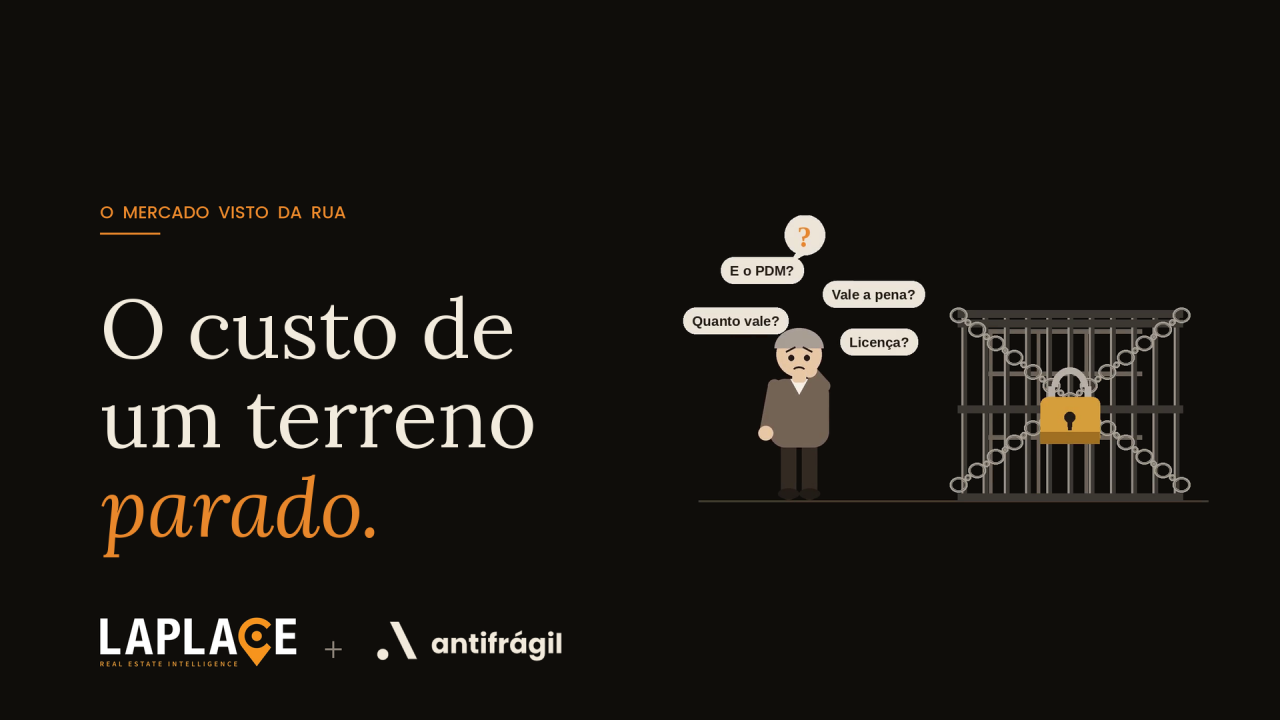
The week was split between Lisbon, Cascais and Porto. Lots of questions from owners about the potential of their land, but many are also reluctant to invest — whether for lack of knowledge, lack of financial capacity or because "dealing with the councils is hell".
This is where we've been trying to help bust myths and remove some barriers, always offering a partnership perspective and never looking at people as "mere clients". The feedback has been very positive and keeps us motivated.
Sentiment: "Step by step, doing it right."
André Casaca
If someone had told me in December 2025 that today we'd be running planning applications for more than 300 homes, I wouldn't have believed them. Today it's a fact. And not by chance.
Most owners, developers and investors run from the uncertainty of complex planning applications. It's understandable: the timeline is open-ended, the dependencies are many, and for months there may not be a single sign of progress. It's like running a marathon without knowing where the finish line is — except that here, unlike the runner, nobody guarantees it exists at the distance you expect.
We choose those processes, with a purpose: to unlock the value of real estate assets. Because that is exactly where the return nobody else is willing to chase lies. High risk keeps the competition away.
What separates those who win from those who give up isn't tolerance for stress; it's knowing how to read the road when the finish line isn't in sight, and having the stomach to run it anyway.
The uncertainty hasn't gone away. I still feel it every day; it's hard. But I've learned to tell the absence of visible progress from the absence of real progress. They're not the same thing. It's that reading — knowing where value is sitting idle, waiting to be released — that turns waiting into strategy.
Sentiment: "To make things happen, better to break than to bend."
Miguel Amaral, AssocRICS
The owner and the investor in a possible deal with several complexities have various friends and relatives in common, and bumped into each other by chance at an event. Given how close they are, they agreed to talk briefly about it somewhere more private.
What does the owner do? He lets us know about the situation and says he'll keep us posted, not without first asking whether we're comfortable with it. Transparency, respect and correctness — touché!
A few weeks ago I sensed widespread pessimism and an apathetic, stalled market. Now there doesn't seem to be enough time for all the processes we're analysing and taking forward. What changed? Nothing!! Bad weeks are normal; the return on our work simply doesn't arrive every day, week or month. When the path is well defined, with criteria, the chances of success rise — and, fortunately, a good share of those possibilities currently depends solely on us.
Sentiment: "Is it Sunday yet? :)" — or — "Lots of leaves; let's see if we get grapes!"
Pedro Almeida
This week I felt again that the market isn't stalled. It's more demanding. There's capital available, there's demand and interesting opportunities keep appearing. But there seems to be less and less tolerance for poorly explained risk.
Today, an asset no longer lives on potential alone. It needs a clear thesis, a price that can be defended, well-identified risks and a realistic path to execution.
The market is still active, but it asks more, takes longer and wants more proof. When that foundation is missing, it doesn't disappear — it simply slows down, chooses better and is less willing to buy assumptions.
Sentiment: "The market is still alive, but it no longer validates just any assumption."
João Franco, the grumpy guest
This week I spoke to an architect at a municipal council (I refuse to call her an "officer") and this is what happened:
- an online meeting (some councils don't even have that yet);
- she understood our request immediately;
- she went through 3 folders of amendments to the permit (1980s, with 8 amendments);
- she tried to help us fit our request into a permit that clearly has a serious error: it makes the basement parking spaces mandatory rather than a maximum;
- she tried to persuade her boss and colleagues that we should be allowed an extra basement level to fit those spaces (without changing the subdivision).
She called us back: she hadn't managed to persuade her boss or colleagues. So she did the following:
- she told us exactly which PDM articles to cite to justify fewer parking spaces while complying with the PDM;
- she sent us the minutes of the meeting with all of this in writing, to attach to the design statement.
If we paid council architects on results and quality of work, rather than on date of birth, this country would be a very different place.
In ten years' time, this architect will either have become like her colleagues or have left.
Sentiment: "What a rarity. What a breath of fresh air."
João Botelho, Executive Director, CONSTRU by Grupo Casais, guest of the week
In recent weeks, in commercial contacts with potential clients whose projects are still at the design, planning or authorisation stage, I've come across a common feeling: uncertainty.
It's extraordinary that a country of "only" 89,000 km² demands a multiplicity of documents, authorisations, undertakings and opinions from various bodies, among other things, which differ from area to area.
Add to that the lack of uniform response times, a variable that depends on human factors that are hard to control, predict and, above all, justify to those who invest and decide.
By contrast, and fortunately, in the construction phase the path of industrialisation and technological innovation is already being trodden, with a visibly positive impact on the efficiency, quality and transparency of processes.
The question that remains: "Is it really so complicated to promote more uniform procedures, in deadlines and documents, in our country? Or is it precisely because it's complicated that it's so necessary to tackle it in a structured, consistent way?"
Want the next edition? Subscribe to the Sentimento de Mercado newsletter.
Opinions of the Laplace team on the market. Market information; not investment advice.
Frequently asked questions
Is the property market in Portugal stalled?
No, the market isn't stalled; it's more demanding. There is still capital available, demand and opportunities, but less and less tolerance for poorly explained risk or assumptions without a solid basis.
Why do many owners and investors avoid complex planning applications?
Because the uncertainty is high: response times are open-ended, there are many dependencies between bodies and for months there may be no visible sign of progress. That uncertainty keeps most of the competition away, leaving room for those willing to read the process and chase the return others avoid.
What does a real estate asset need to be considered credible by the market today?
Potential alone is no longer enough: it needs a clear thesis, a defensible price, well-identified risks and a realistic path to execution. Without that foundation the market doesn't disappear, but it slows down, chooses better and stops buying assumptions.
What are the main problems with planning consent in Portugal?
The demand for multiple documents, authorisations and opinions from various bodies, which change from one part of the country to another despite Portugal's small size. Add to that the lack of uniform response times at the councils, which depend on human factors that are hard to predict.
Um abraço e até breve
Laplace